The Guaranteed
Rent Specialists

1-5
YEARS

Year: 2016

  • Illegally Installing A Gas Boiler

    Illegally Installing A Gas Boiler

    An unregistered gas fitter has been received a suspended prison sentence for illegally installing a gas boiler and undertaking landlord’s gas safety checks at a privately tenanted property.

    The boiler he installed was later classed as dangerous.

    Christian Winter, 35, trading as CJS Winter Plumbing & Heating Services of Ashburton in Devon, was illegally installing a gas boiler at a property in Kingskerswell, also in Devon.

    He then undertook landlord’s gas safety checks at the tenanted property despite having no competencies in gas work or being registered with Gas Safe Register for any gas work. He then deceived the landlord of the property by using a fictitious Gas Safe Register registration number on the landlord’s gas safety records he produced.

    Exeter Crown Court heard Winter’s illegal gas work came to light when the boiler he had installed and which he then passed as safe over the next three years was inspected by a properly registered member of Gas Safe.

    The gas engineer found a number of faults on the gas installation and classed the gas work as dangerous.

    On investigation the Health and safety Executive found Winter had used fraudulent Gas Safe registered details to deceive the landlord: when the landlord was informed of the defects she challenged Christian Winter but he continued to lie to her by stating that he was a registered gas engineer.

    Winter pleaded guilty to breaching Regulation 3(3) and 3(7) of the Gas Safety (Installation and Use) Regulations 1998 and Section 3(2) of the Health and Safety at Work etc. Act 1974 and was given a suspended prison sentence of 12 months; ordered to undertake 200 hours unpaid work and to pay £3,327.80 costs.

    Blog Post from Letting Agent Today

    See details of our Guaranteed Rent Scheme here

  • Councils must follow Housing Ministers guidance on rehousing applicants

    Councils must follow Housing Ministers guidance on rehousing applicants

    Brandon Lewis the Housing minister has sent out correspondence to every local council to provide clear and precise guidance on homelessness.

    Richard Merrick of PIMS, said: “We welcome this guidance, as it is a common known fact that most councils will tell tenants, who have received eviction notices, to stay put until the bailiffs come in and then they will re-house them.”

    The councils who are offering this advice are contradicting government guidance that says they must look to re-house tenants as soon as the eviction notices are served; and not when a possession order has been granted by a court.

    Brandon Lewis’ correspondence says: “The statutory Homelessness Code of Guidance, which local authorities are required by law to have regard to, is clear on this matter.

    “It contains guidance on how authorities should treat homelessness applications in circumstances where a tenant has received a valid S21 notice.

    “It says that housing authorities should not, in every case, insist upon a court order for possession and that no local authority should adopt a blanket policy in this respect.

    “Unless a local authority has very good reason to depart from the statutory guidance, then they should not be placing households in this position.”

    Edicts from the Housing Ministers are wonderful but in terms of the reality facing Landlords PIMS suspect little will change and abuse will continue

    • Tenant not paying rent – the council are not obliged to house them for they made themselves voluntarily home so will tell them to stay put until court order and Bailiff.
    • NEW- Preventing retaliatory eviction The landlord serves notice and the council inspect the property – should they find fault then the landlord is NOT entitled to reserve a new notice for a further 6 months. Therefore no risk of them being homeless
    • 4 million people want a council house and there aren’t 4 million free homes so council.
    • Economics vs reality – as a example a mother with three children is served a notice to vacate. If the council provide emergency housing at expiry of the notice then the council incur significant fees for B&B whereas if they delay eviction and leave the problem with the landlord they could save 8 weeks B&B for two rooms. What do you think the council will do?

    Blog Post from PIMS.co.uk

    Central Housing Group’s ‘Guaranteed Rent’ Scheme protects landlords from the substantial risk of rent arrears, costly evictions and wilful tenant damage. Our landlords are paid an agreed monthly Guaranteed Rent for the duration of the term of their contract regardless of their tenants’ financial or employment circumstances and regardless of whether their property is occupied or not.

    Landlords – please carefully consider the risks you run by choosing to let your property privately when, instead, you can let your property on our ‘Guaranteed Rent’ Scheme and protect yourself from any rental loss exposure or legal eviction costs. 

    When you let your property on our ‘Guaranteed Rent’ Scheme either our local authority clients will assume full legal and financial responsibility for the eviction of your tenants or we will, depending on the nature of the letting of your property – consequently you can be assured that you will not incur any legal eviction costs at all when letting your property to us and, furthermore, you can also be assured that you will continue to receive full monthly rental payments from us until vacant possession of your property has been lawfully obtained!

    If you are interested in finding our more about our ‘Guaranteed Rent’ Scheme, currently operating in north, east & west London, please call us today on 020 8447 1222.

    See details of our Guaranteed Rent Scheme here
    See details of Rent to the Council here

  • Landlords risk prison sentences for failure to checking gas boilers

    Landlords risk prison sentences for failure to checking gas boilers

    A landlord has received an eight week suspended sentence for not carrying out the necessary gas boiler check by a qualified engineer.

    The London landlord was given the sentence by magistrates after they were told he had failed to ensure that a proper gas safety check was carried out, in his property, to obtain the safety certificate from the Gas safety Register.

    The tenant in the property raised alarms about a carbon monoxide leak and the gas supply was immediately switched off by the National Grid.

    The tenant then contacted the Health and Safety Executive about the situation, which then took action against the landlord.

    The landlord admitted his guilt of breaching Regulation 36(3) of the Gas Safety -Installation and Use -Regulations 1998 and received an eight week prison sentence, which was suspended for 12 months.

    He was also ordered to pay £300 in costs to the Health and Safety Executive and an £80 victim surcharge.

    Blog Post from PIMS.co.uk

    Central Housing Group’s ‘Guaranteed Rent’ Scheme protects landlords from the issues highlighted in this article. An integral aspect of our professional management service is to offer advice to our landlords on all relevant legal, health and safety regulations concerning their properties. Our ‘Guaranteed Rent’ Scheme  incorporates regular reminders, as necessary, and arrangement, if instructed, of all appropriate statutory Gas and Electrical safety checks and works, on our landlords’ behalf. 

    Our comprehensive management service reassures landlords that they have all bases covered.

    If you are interested in finding our more about our ‘Guaranteed Rent’ Scheme, currently operating in north, east & west London, please call us today on 020 8447 1222.

    See details of our Guaranteed Rent Scheme here

  • Landlords face increased costs for gaining possession of their property

    Landlords face increased costs for gaining possession of their property

    Landlord Court Fees increase March 2016
    30th Mar 2016

    As from 21st  March 2016 the court’s fees for possession were increased as follows
    SECTION 21 ACCELERATED POSSESSION was £280 now £355 (in 2014 the fee being £175).

    Issuing a Claim for Possession – After the expiry of a Section 21 applying to court using the Accelerated Possession application fee now £355

    SECTION 8 RENT ARREARS ONLINE – was £250 now £325 (in 2014 the fee being £100).
    This can ONLY be used where Section 8 Notice issued for rent arrears ONLY

    SECTION 8 NON Rent Arrears – Now £355 was £280 (in 2014 the fee being £175)
    This is a more complicated process see – NON Rent related grounds FREE 15 PAGE GUIDE Dealing with Possession NON rent arrears

    Applying for a Bailiff – The issue of a Warrant of Possession remains at £110.

    The Civil Proceedings and Family Proceedings Fees (Amendment) Order 2016 means the Government have now implemented these increases which came into effect on Monday 21st March 2016 see legislation

    Application fees have also increased to £255 for contested applications made on notice (previously £155) and £100 for applications made by consent (previously £50).

    Claims for losses via money claims, remain as below see How to Recover Debt
    The fee for claims from £1 – £9,999 will remain unchanged;

    • The fee for claims from £10,000 – £199,999 will now be five per cent of the claim; and
    • The fee for claims £200,000 and above will be fixed at £10,000.

    Blog Post from PIMS.co.uk

    Central Housing Group’s ‘Guaranteed Rent’ Scheme protects landlords from the substantial risk of rent arrears, costly evictions and wilful tenant damage. Our landlords are paid an agreed monthly Guaranteed Rent for the duration of the term of their contract regardless of their tenants’ financial or employment circumstances and regardless of whether their property is occupied or not.

    Landlords – please carefully consider the risks you run by choosing to let your property privately when, instead, you can let your property on our ‘Guaranteed Rent’ Scheme and protect yourself from any rental loss exposure or legal eviction costs. 

    When you let your property on our ‘Guaranteed Rent’ Scheme either our local authority clients will assume full legal and financial responsibility for the eviction of your tenants or we will, depending on the nature of the letting of your property – consequently you can be assured that you will not incur any legal eviction costs at all when letting your property to us and, furthermore, you can also be assured that you will continue to receive full monthly rental payments from us until vacant possession of your property has been lawfully obtained!

    If you are interested in finding our more about our ‘Guaranteed Rent’ Scheme, currently operating in north, east & west London, please call us today on 020 8447 1222.

    See details of our Guaranteed Rent Scheme here
    See details of Rent to the Council here


  • Change That Will Affect The Evictions Process

    Change That Will Affect The Evictions Process

    The vast majority of tenants are unaware of new laws introduced today which change Section 21 and the evictions process.

    From today, under the Deregulation Act 2015, landlords will be unable to end a tenancy using a Section 21 notice if they fail to address a repairs complaint made by a tenant which is then referred to a local authority.

    On top of this, at the start of a new tenancy a landlord must provide tenants with a valid Energy Performance Certificate, an annual Gas Safety Certificate and a copy of the government’s How To Rent guide in order to legally serve a section 21 eviction notice in the future.

    There are also changes to how long a Section 21 notice will be valid for as well as a new Section 21 notice.

    A survey of 1,000 tenants, carried out by the National Landlords Association (NLA) last month, found that 88% are unaware of today’s law changes.

    The study also found that 9% of tenants said they were asked to leave a private rented property after asking for repairs or maintenance to be carried out and some 78% said their last tenancy ended at their own request.

    Now that the changes have been introduced, the NLA is calling on local councils to provide a clear framework for how they plan to deal with complaints in order to ensure that legitimate ones are taken seriously and that spurious ones don’t unnecessarily prolong the evictions process.

    “These kinds of evictions are extremely rare but we have to make sure that complaints by tenants don’t just get lost in the system, regardless of whether they’re legitimate or not,” says Richard Lambert, NLA chief executive.

    He says it is of paramount importance that the new system isn’t abused by those trying to prolong the evictions process as the majority of landlords choose to end a tenancy only when it’s ‘absolutely necessary’.

    “We all know that local councils are under-resourced but housing problems must take priority. If a tenant complains about a potentially hazardous issue then both they and their landlord should have a clear expectation of how and when the council will deal with it,” Lambert adds.

    “If councils fail to act on complaints then it will undermine the law and tenants’ confidence in a system that’s supposed to protect them”.

    Bog Post from Landlord Today

    Central Housing Group’s ‘Guaranteed Rent’ Scheme protects landlords from the substantial risk of rent arrears, costly evictions and wilful tenant damage. Our landlords are paid an agreed monthly Guaranteed Rent for the duration of the term of their contract regardless of their tenants’ financial or employment circumstances and regardless of whether their property is occupied or not.

    Landlords – please carefully consider the risks you run by choosing to let your property privately when, instead, you can let your property on our ‘Guaranteed Rent’ Scheme and protect yourself from any rental loss exposure or legal eviction costs. 

    When you let your property on our ‘Guaranteed Rent’ Scheme either our local authority clients will assume full legal and financial responsibility for the eviction of your tenants or we will, depending on the nature of the letting of your property – consequently you can be assured that you will not incur any legal eviction costs at all when letting your property to us and, furthermore, you can also be assured that you will continue to receive full monthly rental payments from us until vacant possession of your property has been lawfully obtained!

    If you are interested in finding our more about our ‘Guaranteed Rent’ Scheme, currently operating in north, east & west London, please call us today on 020 8447 1222.

    See details of our Guaranteed Rent Scheme here

  • Reminder to agents: new lettings sector energy efficiency rules start today

    Reminder to agents: new lettings sector energy efficiency rules start today

    Today sees the first step of a long-term government drive to improve energy efficiency in the private rental sector through the MEES programme – Minimum Energy Efficiency Standards.

    Ultimately this will make it unlawful from April 2018 to let homes in England and Wales which do not achieve a minimum Energy Performance Certificate rating of ‘E’.

    From today all private sector residential tenants have the right to request energy efficiency improvements to their properties. This applies to longer-term assured and regulated tenancies. Providing no upfront costs are required, any landlord who declines to improve the energy efficiency could be deemed ‘unreasonable.’

    If a tenant considers that the landlord has not complied with the regulations, they can take the case to a First-tier Tribunal General Regulatory Chamber, which will hear and determine applications.

    That’s the immediate change but then there are later deadlines too.

    From April 2018 a landlord cannot grant a new tenancy of the property with an EPC rating below an E and April 2020 when it will apply to all rented properties.

    It is likely – but not so far confirmed – that the minimum standard is likely to rise to a D rating by 2025 and a C Rating in 2030.

    Blog Post from Letting Agent Today

    Central Housing Group is a residential Letting and Management agency, established in 2000.

    We achieved national acclaim after winning the ‘Green Letting Agent of the Year 2014’ award, hosted by the UK Landlord Accreditation Partnership, when our team attended the UK Landlord Accreditation Partnership (UKLAP) Conference & Award Ceremony at the Thistle Hotel in Marble Arch in March 2014.

    We specialise in supplying local authorities with privately rented accommodation across London.

    We are proud to have been recognised for our green contributions in recent years and to have won a national award for our efforts, as we have worked tirelessly to improve the energy efficiency of all properties in our management, playing our own small part in reducing energy consumption in homes we manage across London under our Guaranteed Rent Scheme.

    We have arranged for 70 properties under our management to have their lofts and cavity walls insulated. We were also able to secure funding, via the Mayor of London and the Energy Saving Trust, to enable us to replace and upgrade 35 boilers and complete gas central heating systems with ‘A’ rated energy efficient condensing boilers plus replacement of radiators, timers, thermostats and radiator valves, all free of charge to our landlords.

    We are committed to assisting our tenants in saving on energy costs and to reducing the number of households that are experiencing fuel poverty.

    See details of our Guaranteed Rent Scheme here

  • ‘Landlords facing delays in Courts to repossess rental properties’

    ‘Landlords facing delays in Courts to repossess rental properties’

    It was announced earlier this month that a fifth of all courts and tribunals in England and Wales are to be closed over the next few years.

    Modernisation plans mean that 86 of England and Wales’ 460 courts and tribunal hearing centres will cease operations, starting as early as this month and running all the way through till September 2017.

    According to Ministers, one of the main reasons this is happening is because many of these court buildings are unused for long periods of time. They say that on average, the 86 courts that are closing are used for just over a third of their available hearing time – equivalent to less than two days a week.

    What’s more, according to Justice Minister Shailesh Vara, many of the courts and tribunal hearing centres which are being closed are expensive to run and are unsuitable for modern technology.

    In a written statement, Vara noted that the Government is investing some £700 million between now and 2020 to update the courts system. Modern IT systems – including Wi-Fi – will be installed in a bid to make the justice system more ‘efficient and effective for modern users’.

    Vara states that online plea, claims and evidence systems as well as video conferencing will be implemented, reducing the need for people to travel to court.

    Opposition has come from the Law Society, which says that the closures could limit access to justice. The organisation is gathering views and case studies from its members and has also produced a ‘campaigner pack’ to help people raise any issues they may have with their local MP.

    A representative of the Magistrates’ Association charity told the BBC that the organisation’s members were worried about the impact of the closures.

    “There will be inevitable additional pressure on the system and the paramount concern of magistrates is for accessible justice to be protected,” they said.

    What could these closures mean for landlords?

    Longer journeys

    Landlords who are evicting tenants after issuing a possession order are required to attend subsequent court hearings.

    This is because, according to Government guidance, if a landlord or their representative doesn’t attend a court hearing, it’s likely the judge will dismiss the case outright.

    Therefore, in simplest terms, the court closures could mean that landlords – and tenants – may have to travel further to attend hearings if their local court is one of the 86 being closed.

    However, after the closures, over 97% of people will still be able to reach their required court within an hour’s drive, according to Shailesh Vara.

    Delayed court cases

    The impending closures also raise the question of whether landlords who want to evict will have to wait longer for a court hearing as there will be fewer courts available.

    Considering the Government’s claim, though, that the 86 courts being closed are currently used for just over a third of their available hearing time, it’s possible that this won’t be a significant problem.

    However, it could be more of an issue in areas where there is a higher population density and larger Private Rented Sector (PRS) as court hearings are likely to be more frequent. In London, for example, 10 courts are being closed – so there could be more of a delay for landlords waiting for hearings in the capital.

    Increased costs

    Court hearings can already be a costly exercise and increased travel expenses will push costs higher.

    In this scenario there could also be increased pressure and less margin for error on behalf of the landlord.

    This is because landlords who lose court claims may be ordered to pay tenants’ legal costs. This possibility combined with the extra travel costs and the potential for delays, means court hearings could prove very expensive indeed.

    Fewer possessions

    These potential financial and temporal implications may encourage fewer landlords to try to gain possession of their property during a tenancy. They may also see landlords putting up with tenants in arrears for longer, highlighting the importance of rent guarantee and rent protection products.

    For the majority of landlords, court hearings are of course a rare occurrence – so these closures may not necessarily have a wide-reaching effect on the PRS.

    The best thing you can do in the first instance, however, is to look at the full list of closures to see if your local court is closing and if so, when.

    Then you can determine where your alternative court is so that you can gauge how these changes may affect you and in the event of a court hearing or tribunal, you’ll know where you’re expected to go.

    Which could be the first courts to be closed?

    The following list details the 26 courts which could potentially be closed anytime between now and June this year:

    London
    – Richmond-upon-Thames Magistrates’ Court
    – Hammersmith County Court (formerly West London County Court)

    South East
    – Basildon Social Security and Child Support Tribunal (Acorn House)
    – Dartford Magistrates’ Court
    – Lowestoft Magistrates’ Court, County Court and Family Court
    – West Berkshire (Newbury) Magistrates’ Court

    South West
    – Barnstaple Crown Court

    Midlands
    – Shrewsbury Magistrates’ Court
    – Solihull Magistrates’ Court
    – Worksop Magistrates’ Court
    – Buxton Magistrates’ Court and County Court
    – Corby Magistrates’ Court
    – Grantham Magistrates’ Court
    – Kettering Magistrates’ Court

    North East
    – Morpeth County Court

    North West
    – Accrington County Court
    – Accrington Magistrates’ Court
    – Kendal Magistrates’ Court and County Court
    – Ormskirk Magistrates’ Court and Family Court
    – St Helens Magistrates’ Court
    – Tameside County Court
    – Trafford Magistrates’ Court and Altrincham County Court

    Wales
    – Carmarthen Law Courts (The Guildhall)
    – Holyhead Magistrates’ Court
    – Prestatyn Magistrates’ Court
    – Dolgellau Crown Court and Magistrates’ Court

    Blog Post from HomeLet

    Central Housing Group’s ‘Guaranteed Rent’ Scheme protects landlords from the substantial risk of rent arrears, costly evictions and wilful tenant damage. Our landlords are paid an agreed monthly Guaranteed Rent for the duration of the term of their contract regardless of their tenants’ financial or employment circumstances and regardless of whether their property is occupied or not.

    Landlords – please carefully consider the risks you run by choosing to let your property privately when, instead, you can let your property on our ‘Guaranteed Rent’ Scheme and protect yourself from any rental loss exposure or legal eviction costs. 

    When you let your property on our ‘Guaranteed Rent’ Scheme either our local authority clients will assume full legal and financial responsibility for the eviction of your tenants or we will, depending on the nature of the letting of your property – consequently you can be assured that you will not incur any legal eviction costs at all when letting your property to us and, furthermore, you can also be assured that you will continue to receive full monthly rental payments from us until vacant possession of your property has been lawfully obtained!

    If you are interested in finding our more about our ‘Guaranteed Rent’ Scheme, currently operating in north, east & west London, please call us today on 020 8447 1222.

    See details of our Guaranteed Rent Scheme here


  • ‘Number of rental repossessions hits record high’

    ‘Number of rental repossessions hits record high’

    Last month the Ministry of Justice (MoJ) published its latest figures on landlord claims, evictions and repossessions.

    The headline figure was that in 2015 there were over 42,000 repossessions of rental properties made by county court bailiffs – the highest annual figure the MoJ has recorded since it started measuring this data in 2000.

    The latest data also covers the number of claims for possession made by landlords as well as the split between the private and social rental markets.

    So are evictions and repossessions becoming more common? Well, it’s hard to say definitively as the rental sector has grown so much in recent years.

    What is clear, though, is that claims and evictions are something that many private landlords have to go through. In fact, a survey we carried out in 2015 revealed that 51% of landlords have had to deal with a problem tenant.

    Here’s a more detailed breakdown of what the MoJ reported:

    Key stats

    1. Orders down by 7%
    The court may grant an order following a judicial hearing which can be either for immediate possession (outright order) or suspended

    • In 2015 the total number of orders made was 118,481, down 7% on 2014 (127,270)

    2. Warrants of possession* down 1%
    Having received an order, or if the terms of a suspended order are broken, the claimant can apply for a warrant of possession

    • The total number of warrants issued in 2015 was 77,600, down 1% on 2014 (78,268)

    3. Repossessions by county court bailiffs up 2%
    Once a warrant has been issued county court bailiffs can repossess the property on behalf of the claimant

    • The total number of repossessions in 2015 was 42,728, up 2% on 2014 (41,967)

    * Multiple warrants may be issued per claim

    Majority of landlord possessions claims were for social housing

    The MoJ data for landlord possession claims shows that in the last 3 months of 2015:

    • 13% (4,898) were made by private landlords
    • 62% (22,690) were made by social housing landlords
    • 25% (9,013) were accelerated claims (which can be either private or social housing landlords)

    How long does the claims process take on average?

    The data from the MoJ showed that:

    Claim to order
    • Orders; from initial claim to order has averaged at 12 weeks for 2015

    Initial claim to warrant
    • Warrants: from initial claim to warrants issued has averaged at 37 weeks for 2015

    Initial claim to Repossessions
    • Repossessions by County Court Bailiffs: from initial claim to Repossession has averaged at 41 Weeks in 2015

    Where does this leave landlords?

    According to the latest figures from Your Move and Reeds Rains, there were a total of 82,900 households behind on more than two months’ rent during Q4 2015. This figure represents an increase in serious tenants arrears of almost 20% when compared with the same quarter in 2014.

    The agencies report that their latest figures for evictions represented 32% of the stock of tenants in serious rent arrears in Q4, meaning approximately one-in-three cases of rent arrears translate into evictions each quarter.

    As tenant arrears rise and many landlords do all they can to avoid the evictions process, the need for rent guarantee and rent protection products is clear. On top of this, landlords must do everything in their power to try and find reliable tenants from the outset – from using trusted tenant referencing services to interviewing potential tenants.

    The problem of the rising number of repossessions could also be exacerbated by Government plans to close 86 courts and tribunals in England and Wales over the next few years.

    Landlords who are evicting tenants after obtaining a possession order may be required to attend subsequent court hearings and fewer courts could mean delayed hearings, increased costs and potentially longer journeys.

    Although the number of repossessions made by landlords still represents a relatively small proportion of the industry, it’s a trend that seems to be rising.

    With this in mind, landlords must make sure they are fully aware of their rights and legal obligations when it comes to claims and evictions, as well as making sure they do everything they can to install trustworthy tenants and protect their investment.

    Blog Post from HomeLet

    Central Housing Group’s ‘Guaranteed Rent’ Scheme protects landlords from the substantial risk of rent arrears, costly evictions and wilful tenant damage. Our landlords are paid an agreed monthly Guaranteed Rent for the duration of the term of their contract regardless of their tenants’ financial or employment circumstances and regardless of whether their property is occupied or not.

    Landlords – please carefully consider the risks you run by choosing to let your property privately when, instead, you can let your property on our ‘Guaranteed Rent’ Scheme and protect yourself from any rental loss exposure or legal eviction costs. 

    When you let your property on our ‘Guaranteed Rent’ Scheme either our local authority clients will assume full legal and financial responsibility for the eviction of your tenants or we will, depending on the nature of the letting of your property – consequently you can be assured that you will not incur any legal eviction costs at all when letting your property to us and, furthermore, you can also be assured that you will continue to receive full monthly rental payments from us until vacant possession of your property has been lawfully obtained!

    If you are interested in finding our more about our ‘Guaranteed Rent’ Scheme, currently operating in north, east & west London, please call us today on 020 8447 1222.

    See details of our Guaranteed Rent Scheme here

  • ‘Our 17 properties will lose £16,000 per year’

    ‘Our 17 properties will lose £16,000 per year’

    Offered no respite in the Budget, landlords are facing a bleak future and a conundrum over how to manage their properties. Existing landlords are caught between an income tax bill which is set to begin rising next year, or the stamp duty hit involved in incorporating their properties now.

    Shirleyann Haig, who owns 17 properties in Liverpool, is in this situation. She and her husband Matt are facing long-term financial ruin if they don’t incorporate – or a big tax hit now if they do.

    There are three main tax policies that are likely to affect landlords’ profitability – all of which are making the future look bleak for the Haigs.

    First, in an unexpected move, the Chancellor, George Osborne, excluded them from a drop in capital gains tax for both higher and basic-rate taxpayers.

    He also confirmed that a 3pc surcharge in stamp duty will go ahead from April 1, as planned in consultation, and scrapped a planned stamp duty exemption for larger landlords, meaning those with more than 15 properties already will also have to pay the extra tax.

    And from April next year landlords will not be able to deduct their mortgage interest payments from their rental income before calculating their tax bill.

    They will effectively be paying tax on their turnover, instead of their profit, and as a result many will suffer a plunge in profit or fall into the red.

    Alan Ward, chairman of the Residential Landlords Association, said: “The decision in the Budget to cut capital gains tax for nearly all assets other than residential property, on top of Stamp Duty changes, is a further assault on rented housing in an attempt to wrongly make landlords the fall guys for the housing crisis.

    “We need 1 million new homes to rent by 2020 and all the Government’s action will do is to deter investment creating an even worse shortage and so drive up rents.”

    Would investing in buy-to-let  via a company salvage some of your returns?

    At the moment, landlords who own their properties through a company – rather than in their own names – are not going to be hit by the change in the treatment of mortgage interest.

    But higher mortgage interest rates applying to company borrowers, combined with set-up costs, mean that setting up a special company – “incorporating” – may not help.

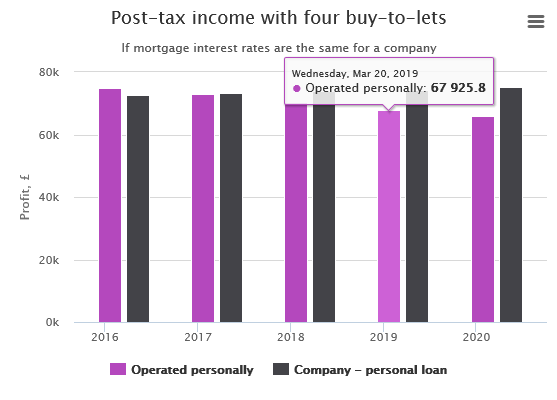
    Figures from accountants Smith & Williamson show that a landlord buying four properties in his own name could see his income drop 14pc by 2021 (when the tax change is fully implemented) if he doesn’t incorporate.

    If he does incorporate, his profits start at a lower level today and recover slowly toward 2021.

    WT_mc_id=e_DM102226&WT


    The calculations take a theoretical buy-to-let investor earning £58,000 from his day job. He buys four properties, each costing £380,000 and each being mortgaged at 75pc of their value at a rate of 2.54pc.

    He receives £19,200 a year in rental income on each (a yield of just over 5pc).

    In year one, after all mortgage costs and taxes are taken into account, his total net income is £74,881.

    By 2021, when the ability to deduct mortgage interest relief is fully removed and replaced instead with a 20pc tax credit, his net income will have fallen to £65,790
    WT_mc_id=e_DM102226&WT_2


    Now assume the same investor buys via a company. The problem is that the mortgage rates are higher at 4.5pc, so his post-tax income drops immediately to £60,496.

    That level of income remains unaffected by the changing tax treatment of mortgage interest. One the face of it, a borrower in these circumstances will be worse off using a company structure.

    If average interest rates offered to landlords in corporations come down –a trend that many brokers are predicting – this could be a more viable option. Equally, landlords with smaller borrowings will fare differently.

    What about properties you  already own?

    For landlords who already own multiple properties, the benefits of incorporating – such as they are – are difficult to capture.

    That is because capital gains tax may apply when properties are sold by the individual, and stamp duty when they are repurchased by his company.

    Jonathan Grant, 36, is facing an increasing tax bill on his four properties in London and Berkshire from next year.

    He hopes that political ambition might prompt an about-turn by George Osborne, who will need the votes of “mainly Conservative” landlord investors.

    “I think he might change his mind if he wants to be Prime Minister,” said Mr Grant.

    “I was very disappointed that there was no reversal on stamp duty. I was looking at buying a block up north somewhere, but I’ll now have to pay the 3pc stamp duty surcharge on that so I probably won’t do it,” he said.

    The tax change will mean our 17 properties will lose us £16,000 per year

    Shirleyann Haig has a large portfolio of buy-to-let properties which currently break even. After the Government’s changes she will be plunged into losses of around £16,000 per year, she reckons – unless she can sharply increase rents.

    At 39 the mother-of-two owns 17 buy-to-let properties on the council estate where she grew up, in Knowsley, Liverpool.

    All the properties are mortgaged at around 70pc of their price and they are jointly owned by her and her husband Matt, 37.

    The mortgage interest payments come to £80,000 a year and are split between the couple.

    The changes will mean that both become higher-rate taxpayers, and their tax bill is set to rocket. But if she wanted to incorporate the business, the bill would be around £100,000 in stamp duty and set-up costs.

    The cost of incorporating

    Shirleyann Haig’s £95,440 bill

    • Mortgage fee £20,800
    • Valuation £6,000
    • Lender legal £3000
    • Broker fee £2000
    • Solicitors £22,000
    • Stamp duty £41,640
    • Plus capital gains tax

    Mrs Haig said: “I thought I was helping people with this business, but I’ve ruined my own life by taking a decision which I thought would be good. And then the Government decided landlords were the devil.”

    “We used every single penny of our savings, and we don’t make much money from the properties. Last year they broke even on paper.

    “It’s very different in the North to how it is in the South East: we can’t rely on the capital growth.”

    The Haigs have worked out that if they don’t incorporate, their extra tax liability would leave them a staggering £16,000 a year out of pocket by the time it has been fully implemented.

    Mrs Haig said: “We take on vulnerable, high risk, homeless, people who can’t get into social housing. We do not exceed the housing benefit allowance. If people’s circumstances change, we drop the rent.”

    To make matters worse, the family are immediately going to be hit by the stamp duty tax hike when it comes in at the start of April, as they are currently renting their own home – and are wanting to buy.

    Because they already own property, they will have to pay the 3pc stamp duty surcharge.

    Mrs Haig said: “I’ve changed jobs so it’s been hard to get a mortgage. I’ve got the kids in school and I’m ready to buy now – but it’s going to be a struggle to get it through before April 1.

    “One day late and I’ll have a tax bill of £11,000. We can’t afford that so we’d have to pull out. We could be left homeless if someone else wants to buy it.”

    Blog Post from The Telegraph

    See details of our Guaranteed Rent Scheme here

  • Homelessness ‘will rocket’ due to the Housing Bill

    Homelessness ‘will rocket’ due to the Housing Bill

    Councils fear the housing bill will see a sell off of homes that will not be replaced and a rocketing of homelessness in communities across Britain.

    The survey of local authorities, treated as a snapshot by the LGA laid out their concerns.

    The key statistics from this survey are:

    –          78% said there would be an increase in homelessness

    –          90% of councils surveyed said their number of council homes would decrease

    –          74% said the homes sold under RTB would not be replaced

    –          82% said there would be less estate regeneration

    The Liberal Democrats have called on the government to think again and take advantage of the remaining stages of the Housing Bill to change the law to help families in housing need.

    Lib Dem leader, Tim Farron, said: “The rise of homelessness because of the government’s housing reforms is utterly appalling. The most vulnerable people in our communities are being completely overlooked. The blame for this lies firmly at the government’s door.

    “When is the government going to do a proper assessment of the impact of their housing reforms on those most in need?”

    Gerald Vernon-Jackson, leader of Portsmouth City Council, said: “This survey confirms our fears about the devastation that will be caused by the Government’s housing reforms. Liberal Democrats asked for this survey to be carried out because we suspected this disastrous impact.

    “A huge reduction in affordable housing is forecasted across the country. The Tories are intent on destroying housing for those most in need.

    “The housing crisis in Britain is desperate, yet the Government is busy giving cash hand outs to help those with wealthy parents buy a nice home while the numbers of homes for everyone else is being slashed.

    “We need to stop this before it’s too late. Liberal Democrats in the Lords have launched a major attack on the reforms and will be fighting them to the bitter end.”

    Blog Post from 24dash.com

    See details of our Guaranteed Rent Scheme here