
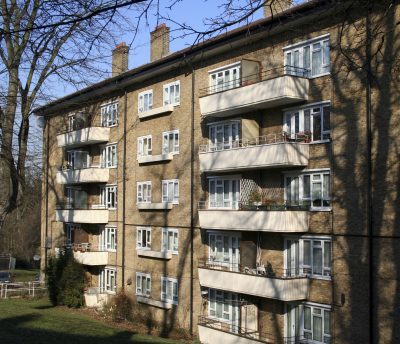
Everything you need to know about buying an ex-council house.
For people wanting to get on the property ladder in London, buying an ex-council house can be a great option.
Not only are ex-council properties cheaper to purchase than the market average, making desirable postcodes more accessible to buyers, they also can be well-designed with more space and storage than newer builds.
However, there can be stigma around buying an ex-council house, the potential to make changes to the property can be difficult, while they can also be more difficult to get a mortgage for.
Here’s what you need to know before buying an ex-council house —and the pros and cons to consider.
The pros of buying an ex-council house: Affordability
If you are already living in a council home, you may be eligible to purchase your home through the Right to Buy scheme. Check your eligibility here.
“It is a massive incentive and buying an ex-council house can have a whopping discount, says Paul Gibbens, marketing executive and property specialist at Housebuyers4u. “However, if you sell within five years you may have to pay back some of this discount.”
Potential buyers might want to consider buying an ex-council house to get more for their money, as according to the Royal Institution of Chartered Surveyors (RICS) they are about 20 per cent cheaper than comparable private properties.
An ex-LA home in Kennington featured in Sarah Thompson’s book Style Council: Inspirational Interiors in Ex-Council Homes
Gibbens adds: “For Londoners, for example, buying an ex-council house may well mean their best chance of affordability living in the Zones especially 1 and 2.
Christian Dugard, founder EXLA London, says: “Ex-council properties are more affordable, with generally lower service charges and in some great locations, for example you could pick up a three-bed garden flat in Zones 1 or 2, close to great transport links, for around £425,000.”
Declan Curran, who lets out several ex-council properties in London, says affordability is the key factor: “Whilst the days of ‘cheap’ London flats are long gone, the fact is that a two-bed ex-LA flat in a tower block somewhere like Kensington or Shoreditch will almost always cost less than a one-bed flat in a quaint period converted house nearby.
“They’re not for everyone of course, but if you’re a first time buyer, or older without kids, or an investor, they can make a lot of financial sense.”
The pros: Location
When developers build new homes, they are now legally bound to provide a percentage of social housing alongside their premium offering.
But Curran points out there was no delineation between so-called desirable areas and local authority housing zones in the 1950s, 60s and 70s when council homes were built. This means buyers may be able to live in a more central location if buying an ex-council house.
“Today’s ‘posher’ areas like Kensington, Notting Hill, Pimlico, Fulham and parts of Chelsea, with of course now-trendy places like Shoreditch and Hackney, saw plenty of council building programmes, which inevitably became available for non-council tenants to purchase in the wake of Thatcher’s ‘80s right-to-buy initiative,” Curran says.
“This means that you can theoretically buy a flat a literal stone’s throw from a ‘posh’ purpose-built private block, sharing a postcode and all that a good area has to offer for much less upfront cost.”
The pros: Design
Council homes were originally built for living and not for profit so have big rooms, ample storage and separate kitchens rather than the safe-saving open plan designs seen in new builds.
“A lot of ex-council properties are very well built, handsome buildings that are very well kept, with period features and interesting histories, you won’t find partitions, just solid walls and floors so you don’t tend to hear your neighbour sneeze,” says Dugard.
Unlike older units such as Victorian houses which have been split into flats or modern new-builds, ex-council properties offer great space and storage.
Curran says: “With these properties house builders and developers can be miserly over every spare square foot, but the post-war social housing boom created swathes of dwellings with fairly generously proportioned bedrooms, hallways, storage areas and kitchens, with layouts which today lend themselves relatively easily to being adapted to modern open-plan spacious living.
The pros: Service charge
Having a fixed amount to pay can be advantageous. (See cons: service charges and hidden costs for disadvantages)
“Ex-council are maintained well whilst in the hand of the council as many councils have dedicated teams of tradesmen to ensure the properties are well maintained and up to standard.” he says.
Alternatively, there may be the opportunity to own the freehold when purchasing an ex-council house, which can make them even better value for money.
The pros: Make interiors one’s own
Innovative council homes interiors are celebrated in the photography book Style Council: Inspirational Interiors in Ex-Council Homes, which includes properties in Bethnal Green, Trellick Tower and Belfont Tower.
Sarah Thompson (@mssarahgracet), the author, says ex-local authority properties offer a blank canvas. She adds: “There’s nothing too wonky or too rooted in a historical period. They’re more like a white cube.”
The pros: Sense of community and belonging
Often ex-council homes are in developments with many people living there, some who have been residents for many years.
Dugard says: “Something that I love about ex-council properties is the sense of community and belonging, how friendly the people are and the diversity of the people who live there.
“If you want to experience the real London and the diversity of the people that make London such a great city, then a council estate is the perfect place to make a home and integrate with the local community.”
The cons: Reluctant mortgage lenders
While brick-built, low-rise ex-council properties in central locations don’t usually have any issues with getting lending from the bank, high-rise buildings or those with cladding can be more challenging to get a mortgage for.
Dugard says: “If the building is non-standard construction, over five storeys or has any hint of cladding without an EWS1, then getting a mortgage can be tricky.
EXLA London has a buyers guide explaining the different criteria the banks have, which can be accessed here.
Dugard adds the main challenge EXLA faces when selling ex-council properties is not a lack of people not wanting to buy them, but the banks not wanting to lend. Reasons can include not enough of a sales history to prove their re-saleability if the owner defaulted.
“I think banks are out of date with their prejudice toward ex-council properties,” he says. “If the banks would lend on these properties there would be a sales history. There is a huge demand from buyers for the ‘difficult to mortgage properties’ but they can’t buy because of the banks refusal to get with the times and realise that these are very sought after properties.
“Of course, if there are concerns over safety due to cladding, I completely understand them not wanting to lend, but, if banks aren’t willing to lend due to concerns over fire safety, then a more important question is should anyone be living in those flats full stop?”
The cons: Stigma
Because council homes were built to provide housing for disadvantaged communities, they can be stereotyped as less desirable places to live.
“There is a stigma around ex-local authority housing,” says Gibbens. “Some council estates have had issues, especially tower blocks which look rather daunting and have no real potential if one was to extend or make some internal layout changes for instance.
Curran adds: “Whilst it might be a difficult subject to broach, it is nonetheless true that some blocks are simply more undesirable than others, with some having much better social cohesion and security than others.
“Visit the block at various times of the day, including late at night, to develop a few for how life will be once you’ve got the keys. If you have any doubts, walk away – there’ll be another.”
It is worth speaking to other people who have experience of living in ex-LA flats, both as tenants and leaseholders.
“Thousands do with no issues, but the broader the range of advice and insight you can glean the better informed you’ll be when you come to make an offer on one yourself,” says Curran.
The cons: Potential
If they are leasehold, it will be difficult to make changes to the design of ex-local authority properties. They also might not increase in value as much as the private property market would.
Gibbens says: “Usually, the capital growth of council houses does not rise so much compared to the private sector and so over the long term one makes less profit on a council house.”
The cons: Service charge and hidden costs
Service charges allow leaseholders to know how much they will be paying. However, buyers will need to consider the cost of service charge and ground rent on top of paying their mortgage.
Gibbens says: “If you have owned the property long enough and happen to be the owner as and when ‘major works’ are required, you will be expected to make a contribution which sometimes can be in the thousands.”
Buyers should find out how long the lease is on the property and also can ask whether any major works are due on the building. These details can be fine tuned during the conveyancing part of the buying process.
Curran says: “Every ex-LA flat will almost certainly be leasehold, meaning that as a leaseholder you’ll be liable for annual service charges, ground rent and a share of any major works bills.”
So far, so normal — the same applies to flats in most private blocks too. But ex-council flats still have a council as a freeholder, and they can be notoriously difficult when it comes to costs.
“With councils being increasingly cash-strapped yet having often self-imposed ‘decent living’ targets to hit, leaseholders can be seen as convenient cash cows to be milked whenever the local authority’s coffers run low. In extreme cases you could be one of, say, four leaseholders in a block of 20 units, with the other sixteen being occupied by council tenants.
“In such a scenario if the block’s roof, lift or brickwork needs major works, involving months of scaffolding and workmen, it isn’t the sixteen tenants who’ll be billed; the costs will instead be largely divided between the four leaseholders, which could be financially devastating.”
Always do as much diligence as you can to ascertain what the charges will be, what, if any, major works might be planned in the coming years, whether any have been carried out recently.
‘I had to overcome my own snobbery about it’
Author Sarah Thompson was inspired to create her photography book after buying her own council home for just over £200,000 as a single mum in Bridport, west Dorset in 2007.
“If I’m honest I had to overcome my own snobbery about it a little bit,” she says. “Council homes don’t always look as pretty from the outside as a Victorian period house or something like that. As soon as I walked through the door of the house as soon as I looked at it I was like wow this had such generous proportions.
“Because of a set of rules that they got rid of in the 60s – every house had to be built with a certain amount of space in each room so that furniture could be moved around.
“I knew quite a lot of people my generation who had been brought up thinking that they’d have these amazing houses and actually you couldn’t so the ex-council sort of gave you another option really. Some of the rural ones you can get are just amazing.
“I think it’s quite important to speak to the bones of a building without wanting to sound pretentious. It’s a 1950s house so I didn’t want to start doing ornate Victorian stuff so I’ve kept it quite simple. I haven’t knocked any walls down because actually that’s the genius of the house is the way that it’s all put together like a toucher’s puzzle.
“A downside is that you can’t necessarily upgrade them too much because you kind of over-spec them.”
Thompson’s book celebrates dozens of council buildings, some designed by important architects, such as Ernő Goldfinger’s Trellick Tower in Kensal Green.
Councils used to employ architects to design and build houses, which they don’t do anymore. The pitfalls include; sometimes they don’t look so nice on the outside. You’ve got to live with that. The growth in price isn’t necessarily going to be the same as with a regular house.
‘I got it so cheap because it was really really unattractive’
However, property prices may have gone up depending on when they were bought. Sarah Moore, 40, is a local government officer, housing. She bought her first home in 2014 – an ex-council one-bed Homes For Haringey maisonette for £165,000. It is now valued by property portals at more than £300,000.
“It was a dump when I bought it, but because it’s an ex-local authority property it had very good bones and straight lines and was built in 1970 so was fairly easy to renovate,” she says.
“It’s basically what I could afford. I’d looked into shared ownership and decided it was a con and I’d looked at new builds in the same price range and just thought they were small and stuffy so this had a lot more for my money.”
As a leaseholder, Moore looked for major works coming up when she bought and managed to get £5,000 off the asking price for £10,000 of planned major works.
But her investment has paid off. And she spent around £15,000 on renovation, keeping costs low by learning to do most of the work herself.
“It’s gone up a lot because the major work has been done now and I’ve spruced it up myself — it’s an attractive property now I think and the area’s gone up as well.”
Moore says the benefits include storage, space, location and the community. And her advice for potential buyers? Don’t be put off by a property that needs a lot of work.
“That’s how I got it so cheap because it was really really unattractive,” she adds.