The Guaranteed
Rent Specialists

1-5
YEARS

Year: 2020

  • London council wants new bureaucracy to manage private renting

    London council wants new bureaucracy to manage private renting

    A London council has launched a strategy it claims will protect private tenants and ensure they live in good quality and well managed properties.

    Westminster has the largest number of private rented sector properties in England with around 52,700: this is 43 per cent of all of Westminster’s housing stock.

    Recent analysis by the council found that 13 per cent of PRS properties in Westminster (almost 6,800 homes) have at least one serious hazard such as faulty electrical wiring, severe damp or mould, excessive cold or fire safety breaches.

    The analysis showed nearly half of HMO’s are likely to have serious hazards.

    In addition, the council says it already receives about 1,600 complaints a year about poor housing conditions in the private sector and the impact of poor-quality housing on residents’ safety, health and wellbeing is significant.

    So its new strategy is to:

    – Improve conditions in the PRS including consulting on a discretionary licencing scheme for all HMOs;

    – The council also aims to review its Enforcement Policy and work with the sector to increase the number of landlords and letting agents signing up to something called the London Landlords Accreditation Scheme;

    – Provide support for tenants, landlords and letting agents by ensuring that all parties are aware of their rights and responsibilities, assisting tenants taking legal action against rogue landlords, setting up a dedicated forum for anyone letting a property privately and investigating energy efficiency grants for landlords housing vulnerable people;

    – Set up a private rented sector forum that brings together all landlords and letting agents so knowledge and best practice can be shared;

    – To lobby government for a national register of landlords and letting agencies, as well pushing for the existing Rogue Landlord Database to be extended, and for tenants’ rights to be simply explained as part of their licence or agreement.

    A council spokeswoman says: “The safety and protection of our communities will always be our primary concern. Most privately rented properties are high quality with landlords that play by the rules, but we know that a minority let properties that do not meet the required safety standards, and put residents’ lives, health and wellbeing at risk.

    “We want tenants, landlords and letting agents to be aware of their rights and responsibilities so we can raise standards in the sector as high as possible. Our new policy sets measures designed to ensure Westminster’s private rented sector is well managed, operating within the law and above all else, safe for the people living here.”


    Blog Post from Letting Agent Today

    See details of our Guaranteed Rent Scheme here

  • A huge degree of pain – London student lettings sector to take 24% hit

    A huge degree of pain – London student lettings sector to take 24% hit

    The private rental sector dedicated to student accommodation in London could see a 24 per cent drop in income in the coming year according to a lettings agency.

    The average London student pays £702 a month in rent, meaning those on a three-year course will pay out £8,424 a year, totalling more than £25,000 throughout their course.

    This means the capital’s student body brings in nearly £271m to London’s rental market in rent each month, with international students accounting for £85.6m of it.

    However, with COVID-19 causing travel restrictions and broader health implications for universities, it’s predicted that the number of students heading to London this term will drop by as much as 24 per cent according to calculations by the Benham and Reeves agency.

    That’s a loss of over £65m a month for the London student rental sector.

    But the agency insists that despite this prediction, many areas of London are still experiencing high levels of demand for student accommodation.

    The agency says the number of student-specific rental properties that have already been snapped up by students sits at 22 per cent – and in some boroughs, the figure is far higher.

    In Merton, for example, it’s 80 per cent while Bromley, Bexley and Barking and Dagenham the proportions are between 60 and 75 per cent.

    Even in more expensive markets such as Hammersmith and Fulham, Islington and Camden, student rental demand is sitting at 19 to 25 per cent.

    “There is currently an evident decline in the level of rental demand from students than we might otherwise expect at this time of year. This has, of course, been driven by a lower number of international students looking for properties due to the travel restrictions and other hurdles that the current pandemic has presented” according to the director of Benham and Reeves, Marc von Grundherr.

    Blog Post from Letting Agent Today

    See details of our Guaranteed Rent Scheme here

  • BREAKING: Housing minister reveals dates for Christmas evictions ‘truce’ for tenants

    BREAKING: Housing minister reveals dates for Christmas evictions ‘truce’ for tenants

    The Christmas evictions suspension is to run from 11th December 2020 until 11th January 2021 during which bailiffs will be told they should not enforce possession orders.

    This announcement has been made by housing minister Christopher Pincher in parliament in answer to a question by Liberal Democrat MP Sarah Olney.

    “In addition, guidance will also be issued to bailiffs highlighting that they should not enforce possession orders in places where local public health restrictions have been introduced by government through legislation,” he said, confirming the government’s previously stated plans.

    At the moment, this would cover huge swathes of the UK where existing local restrictions exist including in parts of Leicester, Bolton, Greater Manchester and the North East, North West, West Midlands and West Yorkshire.

    Onley’s questions had not required such a detailed response; she had merely asked what the government was doing to support renters not covered by the six-month notice period who had been served a Section 21 notice prior to the extension kicking in.

    Figures attacked
    Pincher’s ministry has also attacked figures published recently by Generation Rent and widely quoted in the media in recent days claiming that 55,000 renters face eviction now that the stay on possession hearing has been lifted.

    On Twitter, MHCLG has said that Generation Rent’s figures are ‘unreliable and misleading’ because they only looked at the responses “from 13 individuals to conclude that 55,000 household have been served an eviction notice”, the tweet said.

    Blog Post from Landlord Zone

    See details of our Guaranteed Rent Scheme here

  • Non-Priority Hearings Face Huge Delays For Landlords

    Non-Priority Hearings Face Huge Delays For Landlords

    Evictions expert and TV star Paul Shamplina says landlords must wake up to the reality of the clogged courts system as possessions and other non-priority hearings re-start following the end of the stay on court hearings.

    Shamplina has published an anonymised letter on LinkedIn from a court notifying one of his clients of their trial date, after they decided to pursue the guarantor of their tenant for rent arrears debt. The guarantor is defending the case.

    The landlord in question already has possession of the property.
    But Shamplina and his client were shocked to discover that the trial date set by Edmonton County Court in London is for 23rd October 2021 or in 15 months’ time.

    “Finally, the courts have officially reopened after six months of suspension, but it’s clear that for so-called non-priority hearings such as these, landlords are facing extremely long waits,” says Shamplina.

    The Master of Rolls recently confirmed that the courts will be focusing on a narrow set of priorities when dealing with possession hearings including those involving anti-social behaviour, domestic violence and ‘extreme arrears’ of more than 12 months.

    Samuel Lane, a solicitor at Irwin Mitchell says the extra work being asked of courts – including both ‘Covid grading’ hearing applications and setting a review date to give both sides time to complete mediation – appears to already be “creating further work for an already over-worked system,” he says.

    Shamplina says: “We suspect there are approximately 55,000-60,000 possession cases in the court system now, although 30,000 of those involve social rather than private rented sector tenancies.

    “Let’s wait and see how these court backlogs are dealt with, nevertheless I think these delays will unprecedented, but I hope for many landlords’ sake I’m wrong.”

    Blog Post from Landlord Zone

    See details of our Guaranteed Rent Scheme here

  • UK only 15th best buy to let investment location in Europe

    UK only 15th best buy to let investment location in Europe

    The UK is only the 15th best place in Europe to enjoy high returns from buy to let according to currency company World First – and it trails Bulgaria, Slovakia, Latvia, Poland and Romania amongst others.

    The analysis shows the Republic of Ireland as the best location, with an average rental yield of 6.54 per cent. Then comes the Netherlands, Portugal, Belgium, Hungary, Turkey, Bulgaria and Malta all on over 6.0 per cent.

    The UK average yield is only 4.91 per cent – although its 15th position in the league table is actually six places above where it was placed six months ago.

    However, the UK figures were calculated before the latest announcement by the Bank of England that it was tightening buy to let mortgage criteria further, and of course the league table comes in advance of tomorrow’s Autumn Statement which may – or may not – herald new measures affecting the private rental sector.

    Sitting at the bottom of the table, Sweden, Italy and France provide the lowest returns on buy to let with high property prices and rents that fail to make the investment worthwhile.

    Sweden continues to rank last place for buy to let investments from April – when the data was last tracked – with an average yield of just 3.0 per cent. Italy on 3.26 per cent and France on 3.55 per cent make up the bottom three countries.

    The analysis also shows the gap between rural and urban investment for buy to let in Europe and identifies which areas will see their stake go further.

    The rural-urban gap is most prevalent in Turkey where average yields in rural areas are 6.70 per cent but drop to 5.71 per cent in areas outside the city. In contrast, investors can see the least significant variances in Greece where the average yields are similar in urban (4.48 per cent) and rural (4.41 per cent) areas.

    Blog Post from Letting Agent Today

    See details of our Guaranteed Rent Scheme here

  • Law Society calls for more Legal Aid help to tenants facing eviction

    Law Society calls for more Legal Aid help to tenants facing eviction

    The legal industry says the end of the eviction ban must be the moment to ensure the widest number of tenants across the country have “access to justice.”

    The Law Society of England and Wales says there is a need for wider reform.

    “Possession proceedings must be made more workable in anticipation of the huge increase in cases, the established backlog and the difficult circumstances facing landlords and tenants” according to Law Society president Simon Davis

    “However, in order to protect vulnerable tenants it is vital that legal advice is available to all tenants.”

    He says changes to the Housing Possession Court Duty Scheme – processes undertaken for possession – do not go far enough in ensuring all tenants are afforded legal protections.

    And he adds that “Legal Aid deserts persist in Cornwall and Telford” with the industry concerned about the sustainability of the scheme.

    Davis continues: “It is unacceptable that, in the face of a pandemic and difficult economic prospects, tenants are being left without representation during possession proceedings.

    “The changes to the possessions procedures are a positive step, but they cannot replace legal advice in achieving access to justice. More needs to be done by government departments to support tenants at this time, to prevent them losing their homes and to stop an increase in homelessness

    “They will also have a limited impact where mandatory evictions, such as section 21s, remain available to landlords. Allowing judicial discretion in all current possession proceedings will help to reduce homelessness and encourage better relationships between tenants and landlords. This must be considered if these changes are going to have the intended impact.”

    Blog Post from Letting Agent Today

    See details of our Guaranteed Rent Scheme here

  • How to Calculate Net Rental Yields for Properties

    How to Calculate Net Rental Yields for Properties

    How to Calculate Net Rental Yields for Properties

    If you live in a cosmopolitan area, the ever-increasing cost of renting a decent space is annoying. This is why many people are desirous of having their own homes. To do this, most of them often go for mortgage loans.

    However, beyond owning spaces for personal use, many investors are active in the real estate market in search of a competitive ROI.

    They evaluate the property’s location and if found ideal, they give serious consideration to acquiring it for rent or resale. This reminds us of one of the three most important factors in real estate – location, location and location. To know more on the importance of location in the real estate market, you can click here.

    Apart from the location, consideration for investment should also be determined by things such as “net rental yields”.

    In this article, we will discuss issues revolving around net rental yields and how it influences the decision to buy or backout of a deal in the real estate market.

    Let’s get right into it.

    What Is Rental Yield?

    In the simplest term, it is the ROI (returns on investment) gotten from rents by tenants.

    Because acquiring a property is a capital-intensive venture, when done for the purpose of earning from rent, the numbers have to add up. In the long run, if the profit gotten from rent is good (percentage-wise), the acquisition is said to have a good rental yield.

    How Is Rental Yield Calculated?

    To figure out if a real estate venture is profitable for renting, knowing how to calculate the rental yield is important.

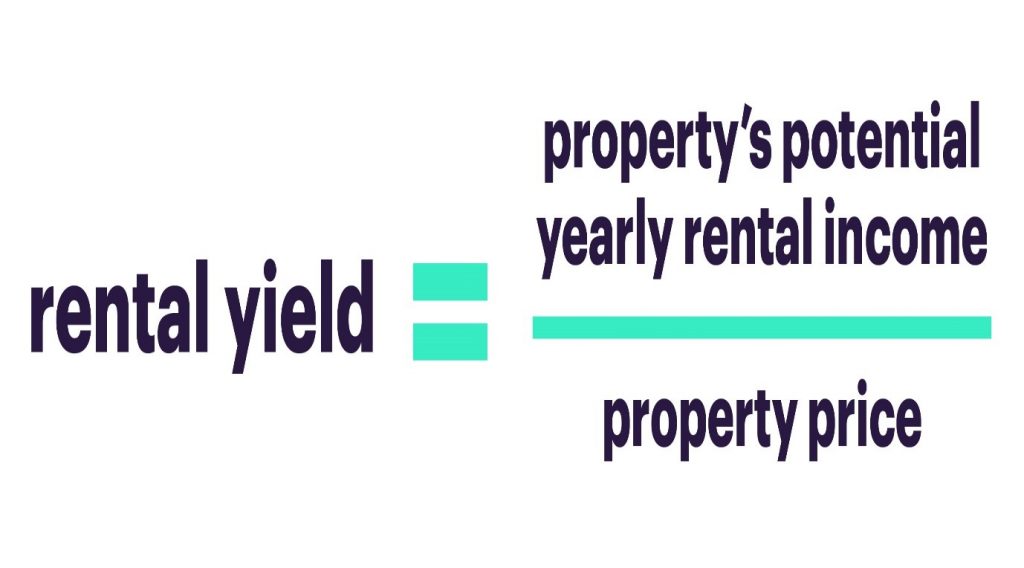
    To have a rough estimate, you are to calculate the expected annual earnings from rent. When you figure that out, divide the number by the purchase cost of the property, then multiply the outcome by 100. This will give you a percentage value of the rental yield.

    Figuring Out A Property’s Net Rental Yield

    You should know that there are other running expenses that should also be taken into account. So, the calculation above will only account for your gross rental yield.

    More than this, the exact profitability or the determination of a good rental yield is determined by the net rental yield. This is the profit gotten after every other expense is accounted for. Let us go over some of these expenses.

    Maintenance Cost

    These are running expenses on things such as electricity tariffs, water supply, waste disposal, among others.

    The maintenance cost is one of the unavoidable running expenses that property investors hoping to make money from renting properties will have to contend with.

    With regard to the rental yield, the higher the cost of maintenance, the lower it will be. On the contrary, if the maintenance cost is low, the earning from rent will be good.

    In places where the cost of maintenance is usually high, property investors often have to increase the rent that tenants pay to be able to stay profitable.

    Tax on Property

    Compared to maintenance costs, this is easy to figure out. The property tax is one of the periodic running expenditures that have to be deducted to get the gross rental yield.

    Cost of Repair

    At certain points, there will be damages and malfunctions to certain utilities in the building. Depending on the agreement with the tenants, property investors may be charged with the responsibility of fixing these damages. This can be problems with the HVAC system, sewage system, power supply around the property, among others.

    Because of the possibility of having to spend on repairs, you do not want to be caught off your guard when the need arises. So, as a property investor, you are supposed to set aside funds to cater for these eventualities.

    The cost of repair is not something that can be easily anticipated and deducted from the gross rental yield beforehand. However, it plays a huge part in determining how profitable the acquisition of a property for rent will be.

    Agency Fees

    This are the fees paid to your broker so that the property can be marketed to old or new tenants.

    Considering their expertise in getting the right kind of tenant, this payment is usually a good investment. However, it is one of the running expenses that should be deducted to arrive at your net rental yield.

    To get more information on the subject of rental yield, you can read this article here: https://www.yourinvestmentpropertymag.com.au/

    On a Final Note

    For property investors aiming to make a reasonable profit from renting their acquired properties, we have in this article looked at a number of things that should be factored in to determine how profitable a real estate investment will be.

    While we have provided a general guide above, it will be in your best interest to have real estate investment experts guide you through the process of choosing the right property to invest in. This will save you both the stress of doing all the calculations and the possibility of making the wrong choice.

    See details of our Guaranteed Rent Scheme here

  • Everything you ever wanted to know about evictions – and more…

    Everything you ever wanted to know about evictions – and more…

    A definitive document has been published by the House of Commons library listing every eviction-related measure taken by UK governments during the Coronavirus crisis.

    The 51 page publication, which also covers anti-homelessness measures, has been released this week to coincide with the end of the eviction ban.

    The document chronicles the measures ranging from the Westminster government’s Coronavirus Act 2020, passed by MPs in March, through to very recent changes such as the requirement announced last month for landlords in England to provide tenants with six months’ notice, except in cases involving issues such as anti-social behaviour and domestic abuse.

    The publication also covers the devolved administrations and social housing provisions, plus relevant changes to the Local Housing Allowance and measures taken by mortgage lenders following guidance from the Financial Conduct Authority, relating to mortgage holidays.

    There is also a useful summary of the debate surrounding evictions during the virus period, including the recent campaign where landlords and housing charities have combined to lobby government for financial help to be offered to tenants in Covid-related arrears.

    Blog Post from Letting Agent Today

    See details of our Guaranteed Rent Scheme here

  • ‘Landlords cannot continue funding tenants where the government should be helping out’

    ‘Landlords cannot continue funding tenants where the government should be helping out’

    NRLA Chief Executive Ben Beadle has appeared on Channel 4 News to defend the government’s decision to remove the stay on possession hearings, the first of which will be heard today in courts around the country.

    Appearing alongside Dan Wilson Craw, deputy director of Generation Rent, Beadle was challenged on whether it was the right time to restart evictions and why landlords need recourse to the Section 21 ‘no-fault’ mandatory eviction process.

    “The courts have put in pretty strict measures to ensure that, if there are local lockdowns, the enforcement of eviction notices will not proceed,” he told Channel 4 reporter Fatima Manji.

    “Landlords aren’t property tycoons and they don’t have massively broad shoulders to be able to carry on funding [tenants] where the government should be helping out.

    “Section 21 notices are not being prioritised under the Master of the Rolls working group guidelines, and only the most serious cases are to rise to the top to be dealt with.

    Beadle told the programme’s seven million viewers that landlords “don’t wake up and think ‘I’ll evict my tenant today’ – there is invariably a fault,” he said.

    “I accept that selling a property is not the fault of the tenant, but we must look at the full financial package that is available to both sides. And landlords have faced increased costs and taxation, so we’re now facing the perfect storm.

    “But this is not the time to be increasing rents.”

    During the programme Wilson Craw’s key message was to call for ‘no fault’ evictions to be banned.

    Beadle countered that the new court rules that went live today “are going to give courts serious teeth including the deprioritisation of Section 21 evictions, which is what Dan is calling for.”

    The government has already announced that it intends to scrap Section 21 evictions once Covid is over.

    Blog Post from Landlord Zone

    See details of our Guaranteed Rent Scheme here

  • Financial package for landlords vital for the survival of the PRS

    Financial package for landlords vital for the survival of the PRS

    Calls for a comprehensive financial package for landlords and tenants form the cornerstone of the NRLA’s submission to Government ahead of the publication of its Comprehensive Spending Review.

    The association says the Government must develop a package that provides much greater support for landlords and tenants to ensure that rents can be paid in full and on time.

    It wants ministers to follow the lead of Wales and Scotland to develop a system of hardship loans to help tenants cover Covid-19 related arrears in England.

    Specifically it is calling for:

    Interest free, government guaranteed loans for tenants affected by coronavirus. These should be paid directly to landlords and should cover all arrears accumulated since the start of the pandemic
    Income support for landlords to cover arrears where affected tenants either refuse to apply for a loan or where loans are not best suited to them
    It also wants reforms to the welfare system, to give both landlords and tenants confidence that payments will cover their basic housing costs.

    The changes it is calling for would see:

    • The Shared Accommodation Rate suspended for 12 months to sustain tenancies and allow house moves where needed
    • The Local Housing Allowance remain at the 30th percentile (at least) and ideally increase to the 50th.
    • Fundamental reforms to the way Universal Credit is structured, by paying it monthly in advance rather than arrears

    The NRLA has also made it clear that any move to increase Capital Gains Tax would be a mistake on the part of the Government, with research showing this would only serve to freeze the market, making life more difficult for tenants.

    The spending review sets out the government’s spending priorities for the next three years. Covid-19 has caused delays, with the full report now expected to be completed and made public before Christmas.

    Meera Chindooroy, deputy director for policy and campaigns for the NRLA said: “Landlords are not property tycoons and the vast majority have just one or two properties which they often rely on for at least part of their income or pension.

    “All of our research shows that in the vast majority of cases where tenants have struggled financially due to Covid-19 landlords have done everything they can to sustain the tenancies.

    “However our latest figures show landlords have lost up to £437m already as a result of Covid-19 and have been unable to access any of the financial support available to other businesses.

    “Landlords cannot shoulder these levels of rent arrears indefinitely, nor should they be expected to.

    “It is time the Government stepped up to support to the hardworking landlords out there providing the homes to let that this country so desperately needs.”

    Blog Post from NRLA

    See details of our Guaranteed Rent Scheme here